Denver’s Police Accountability Crisis: A Pattern of Bypassing Oversight and Weakening Accountability
For more than two decades, Denver residents have fought to build systems of independent police oversight. Those systems were created because communities understood a simple truth: police cannot effectively police themselves.
Today, those hard-won accountability measures are under threat.
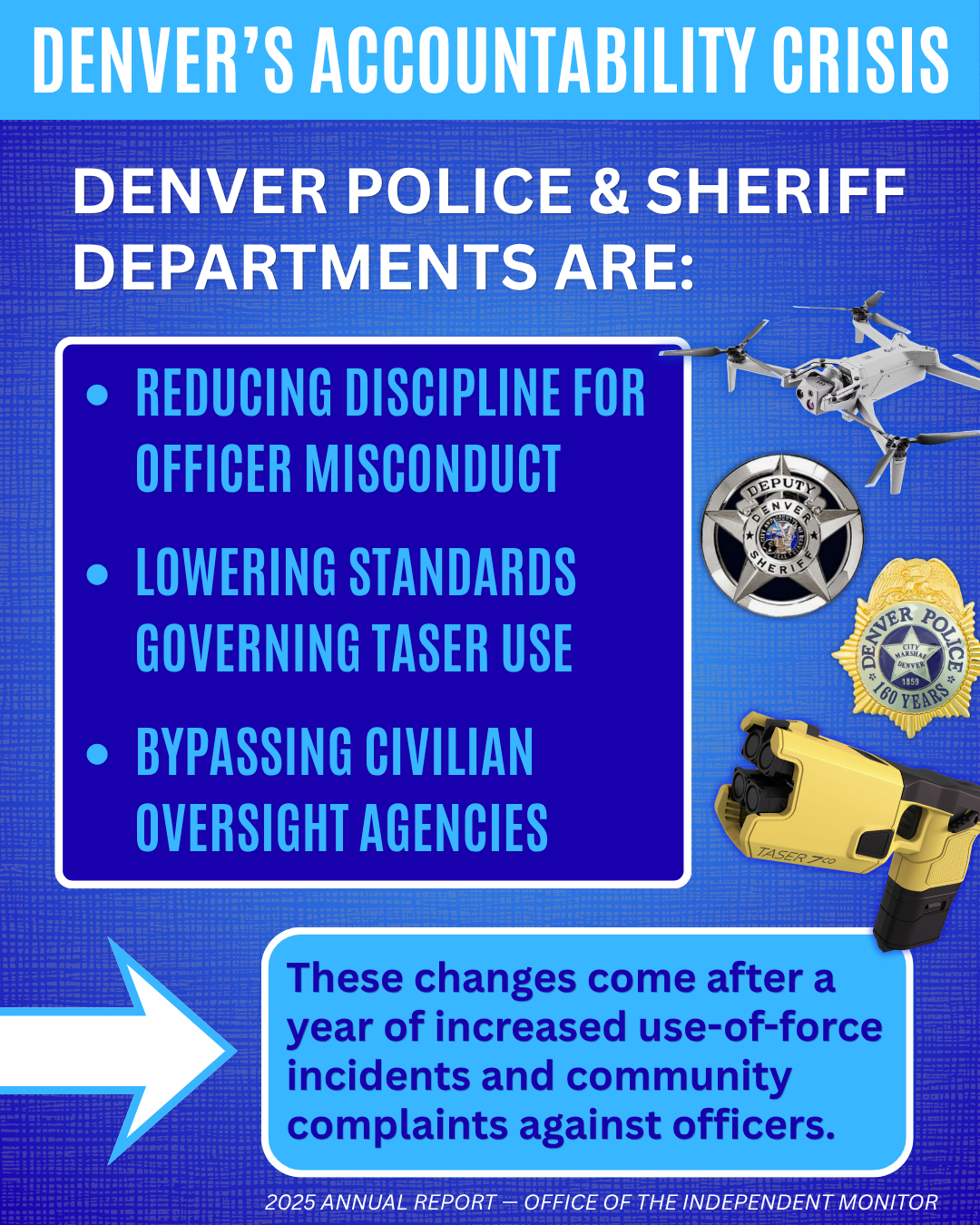
Over the last year, both the Denver Police Department (DPD) and Denver Sheriff Department (DSD) have advanced policies that reduce discipline for misconduct, expand the use of force, and increase surveillance powers—all while limiting meaningful oversight from the Office of the Independent Monitor (OIM), the very agency established to protect transparency, accountability, and public trust.
These changes come amid rising concerns about police accountability, increased use-of-force incidents, and growing community complaints.
A Growing Pattern of Self-Policing
Rather than strengthening accountability systems, Denver’s public safety agencies are moving in the opposite direction.
Recent actions by DPD and DSD reveal a troubling pattern:
- Reducing disciplinary consequences for officer and deputy misconduct.
- Expanding the circumstances under which officers can use force.
- Increasing surveillance capabilities without meaningful public review.
- Moving forward with major policy changes before oversight bodies can complete their reviews and recommendations.
While each policy change may appear separate, together they point to a broader effort to weaken independent oversight and return decision-making power to the agencies being monitored.
Why the Office of the Independent Monitor Matters
The Office of the Independent Monitor was established after years of community advocacy and public concern regarding police violence and misconduct.
Its mission is clear:
- Review misconduct investigations.
- Monitor disciplinary decisions.
- Recommend policy reforms.
- Increase transparency.
- Strengthen public trust in public safety agencies.
The OIM exists because independent oversight is essential to accountability. Its purpose is not to serve as a rubber stamp for departmental decisions, but to provide meaningful review and recommendations before major policy changes are implemented.
The Sheriff’s New Discipline Directive
In May 2026, Executive Director of Public Safety Al Gardner approved a new Sheriff’s Department directive that reduces formal investigations and disciplinary processes for certain policy violations.
Under the directive, some misconduct allegations can be handled informally by supervisors instead of going through traditional disciplinary procedures.
The OIM opposed the policy and raised concerns that it would:
- Reduce transparency.
- Limit accountability.
- Restrict oversight access to misconduct investigations.
- Undermine public confidence.
Notably, there is no publicly available evidence, audit, community survey, or independent research supporting the effectiveness of this change.
Surveillance Drones Introduced Without Public Oversight
In October 2025, Denver Police quietly launched a “Drone as First Responder” pilot program using Skydio surveillance drones obtained through a zero-dollar agreement.
Because no money changed hands, the program bypassed many of the review processes that would typically involve City Council and public scrutiny.
The result was the deployment of a powerful surveillance tool without meaningful public engagement, transparency, or clearly defined civilian oversight protections.
Many community members—and even some public officials—were unaware the program existed until months after it had already begun operating.
A New Taser Policy Expands Use of Force
In April 2026, Denver Police revised its Taser policy, lowering the threshold for when officers can deploy the weapon.
Previously, Tasers generally could be used when officers faced active aggression or a threat of harm. Under the new policy, officers may use Tasers against individuals exhibiting “defensive resistance.”
The Office of the Independent Monitor found that officers had previously received significant discipline for Taser deployments that would now be authorized under the revised policy.
The OIM warned that the change is likely to increase harm to community members while reducing accountability for officers who misuse force.
Education-Based Development: Training Instead of Discipline
Since 2025, Denver Police leadership has advocated for a new disciplinary framework known as Education-Based Development (EBD).
Under EBD, officers who violate department policies may receive training and coaching in place of traditional discipline such as reprimands or suspensions.
The proposal has faced opposition from:
- The Office of the Independent Monitor.
- The Citizen Oversight Board.
- Community organizations.
- Hundreds of Denver residents.
The OIM has repeatedly stated that there is no evidence demonstrating EBD is a best practice for law enforcement accountability and has warned that reducing disciplinary consequences may weaken public trust.
Community members have echoed those concerns. A petition opposing EBD has gathered more than 360 signatures from residents and organizations calling for stronger—not weaker—police accountability.
Denver Law Requires Meaningful Oversight
Denver’s oversight system is not optional.
Under Denver Revised Municipal Code § 2-390(d), public safety agencies are required to provide the Office of the Independent Monitor with notice and an opportunity to review and make recommendations before implementing substantive policy changes.
Yet in multiple instances—including the EBD proposal, the Sheriff’s Department directive, the Taser policy revision, and the deployment of surveillance drones—agencies have moved forward before oversight processes were fully completed or meaningful public review could occur.
The issue extends beyond any single policy.
It is about whether independent oversight has real authority or whether departments can simply move forward with controversial changes while treating community accountability as an afterthought.
When Police Ignore Oversight, Communities Pay the Price
Denver created independent oversight because the city has experienced the consequences of weak accountability before.
When disciplinary systems are weakened, when force policies are expanded, and when surveillance technologies are deployed without transparency, public trust erodes.
Oversight only works when agencies are required to follow it.
If police departments can reduce discipline, expand force authority, and increase surveillance powers while bypassing independent review, then the oversight system becomes symbolic rather than meaningful.
And when accountability systems fail, communities bear the consequences.
Take Action
Denver residents deserve transparency, accountability, and meaningful civilian oversight of public safety agencies.
We encourage community members to:
- Attend Citizen Oversight Board meetings.
- Speak out against policies that weaken accountability.
- Support independent oversight mechanisms.
- Sign and share the petition opposing Education-Based Development (EBD).
The future of police accountability in Denver depends on community participation and vigilance.
Because oversight only works when the public demands it.